KitchenAid KSSC48QMS 02: Inverter Board Failure — No Cooling in Memorial, TX
📞 Call (346) 512-3688🔧 Performed by Serhii T.
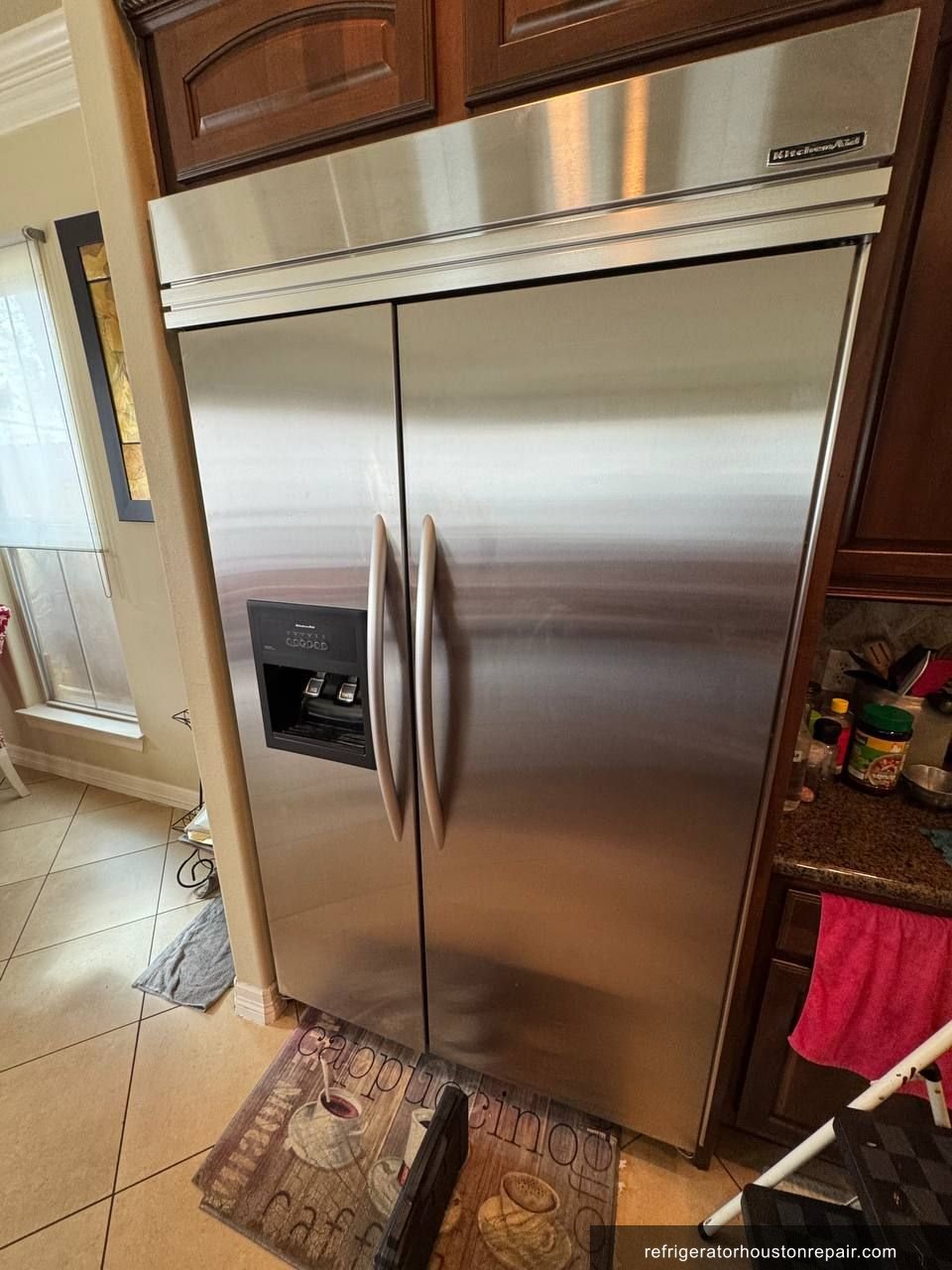
The Problem
- •Refrigerator completely stopped cooling — both fresh food and freezer sections at room temperature
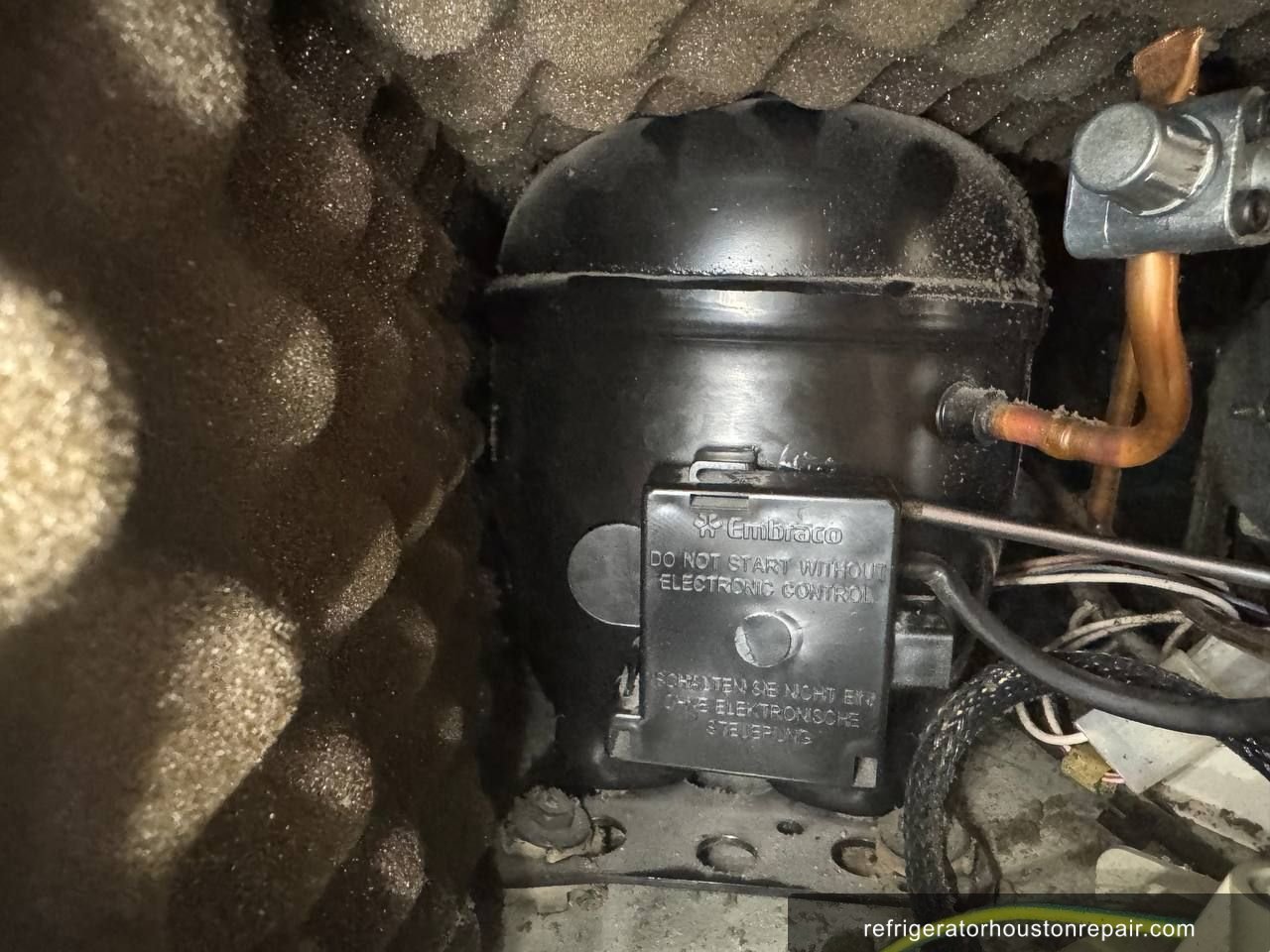
- •Compressor not running — no vibration or hum audible from the back of the unit
- •Low static refrigerant pressure detected at service port with compressor off, indicating a slow R-134a leak somewhere in the sealed system
- •Main control board already previously replaced, suggesting this 2006-era unit had been experiencing electronics failures across multiple boards
🔍 Diagnosis
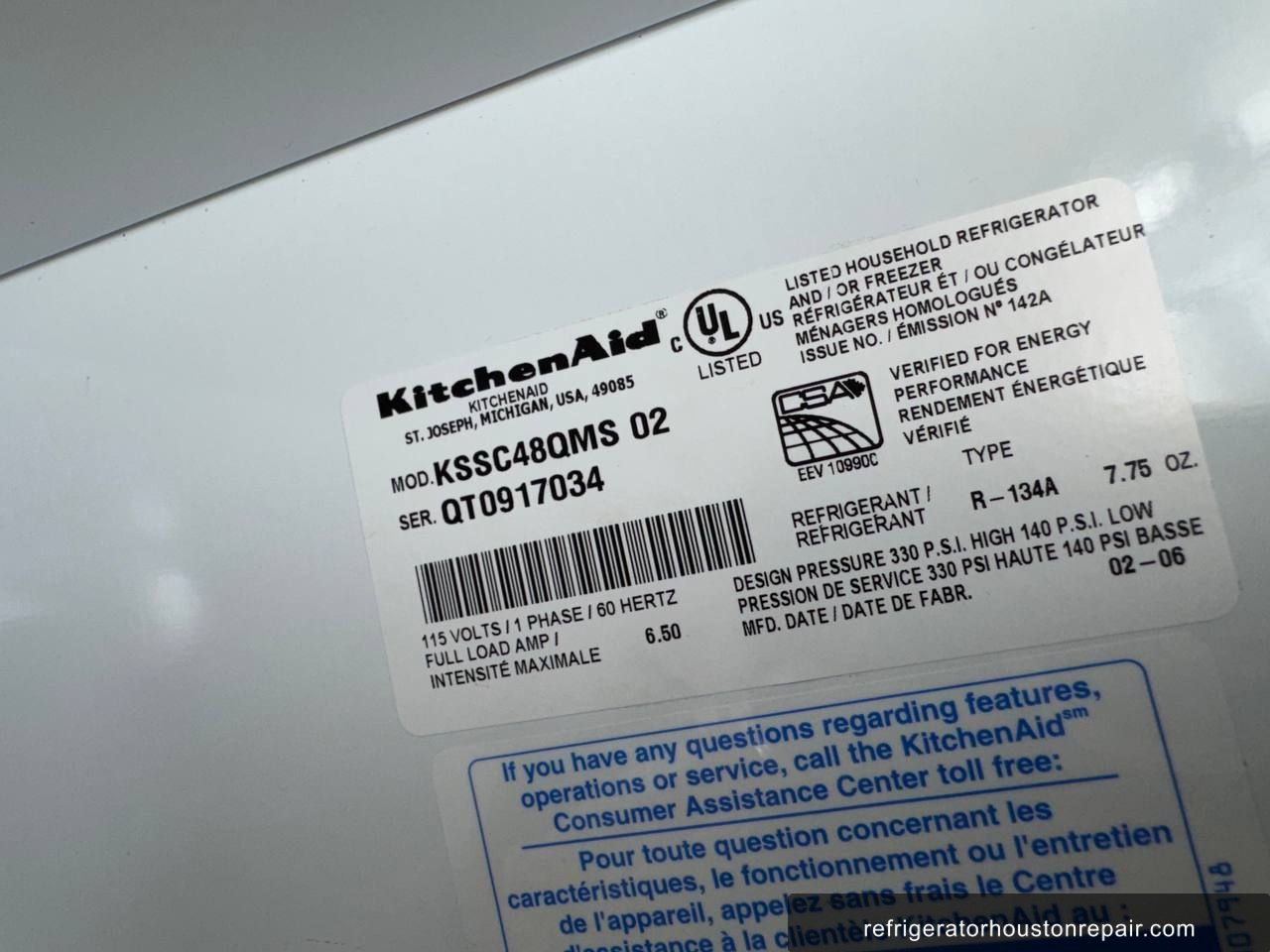
On arrival at the Memorial, TX residence, the technician found the KitchenAid KSSC48QMS 02 — a 48-inch built-in side-by-side — with both compartments fully warm. The compressor was completely silent, producing no vibration and no audible start attempts. This immediately pointed to either a power delivery failure upstream of the compressor or a locked compressor itself. Using a clamp meter on the compressor wiring harness, the technician confirmed zero current draw — the compressor was not receiving a run signal. Attention shifted to the inverter board (also called the compressor control board), which on this model governs variable-speed compressor operation. The inverter board showed no LED status indicators and failed continuity checks at key output terminals. With manifold gauges connected to the R-134a service port, static pressure read approximately 55 PSI — noticeably below the expected 85–90 PSI static equilibrium for R-134a at Houston ambient temperatures (~78°F). This confirmed a refrigerant charge deficit, consistent with a slow leak. The main control board had already been replaced prior to this visit — not unusual for a 2006 unit that has seen nearly two decades of Houston humidity cycling. The inverter board W10629033 is a documented failure point on KitchenAid and Whirlpool-platform built-ins from this era, particularly in high-humidity climates where moisture accelerates PCB corrosion on the low-voltage signal traces.
🔧 The Repair
- ✓Step 1: Disconnected power and accessed the inverter board compartment at the rear lower section of the KSSC48QMS 02. Photographed existing board orientation and wiring harness positions before disassembly.
- ✓Step 2: Removed failed inverter board W10629033 by releasing the three mounting standoffs and unplugging the four-connector wiring harness — compressor leads, DC power input, thermistor signal, and communication line to the main board.
- ✓Step 3: Installed replacement inverter board W10629033 (OEM-equivalent, carried on truck). Reconnected all four harness connectors in sequence and confirmed positive locking engagement on each.
- ✓Step 4: Before restoring power, connected refrigerant manifold gauges to the R-134a low-side service port. Confirmed static pressure deficit — charged the sealed system with R-134a to bring static pressure into the 87 PSI range appropriate for ambient conditions, adding approximately 1.5 oz to the confirmed label spec of 7.75 oz total charge.
- ✓Step 5: Restored power and observed inverter board status LED — solid green confirmed the board initialized correctly and began sending run signal to the compressor.
- ✓Step 6: Verified compressor startup — audible low-frequency hum confirmed variable-speed compressor engaged within 90 seconds of power-on. Clamp meter confirmed current draw of 3.2A on the compressor circuit, consistent with normal startup load for this platform.
- ✓Step 7: Monitored low-side running pressure — stabilized at 22–24 PSI with compressor running, within normal operating range for R-134a on this system. No abnormal pressure fluctuation observed during the monitoring window.
- ✓Step 8: Advised homeowner of suspected slow refrigerant leak (likely evaporator coil) and documented the warning. After a 2-hour runtime, fresh food compartment reached 38°F and freezer reached 0°F — both within KitchenAid spec for this model.
✓ Result
The KSSC48QMS 02 was fully restored to operation the same day in Memorial, TX 77024. After a 2-hour runtime post-repair, the fresh food section stabilized at 38°F and the freezer at 0°F. Total repair cost was $897, which included parts, labor, and the refrigerant recharge. The homeowner was relieved — this is a high-end 48-inch built-in that would cost $8,000+ to replace. They immediately started moving groceries back in from a neighbor's refrigerator where they'd been stored during the service call.
💡 Technician Notes
On KitchenAid built-ins from this era — particularly the KSSC and KBSD series — the inverter board tends to fail before the compressor itself gives out. The early warning sign specific to this failure mode is intermittent cooling: the refrigerator works fine for a day, then stops for several hours, then recovers. This happens because the inverter board is failing thermally — it works when cool but shuts down when it heats up. Homeowners often think the problem resolved itself. It hasn't. For maintenance, keep the condenser coils at the base of this unit vacuumed out every 6 months. Restricted airflow raises board operating temperatures and accelerates inverter board failure on this platform. Regarding the refrigerant: a static pressure reading below 80 PSI on a warm R-134a system is never 'just low charge from age' — R-134a doesn't disappear without a leak path. If your KitchenAid built-in needs refrigerant more than once, the evaporator coil is the most likely leak source on this model and should be inspected before recharging again.
Frequently Asked Questions
KitchenAid KSSC48QMS not cooling at all — compressor not running, what's wrong?
On the KSSC48QMS, a completely silent compressor is most often caused by a failed inverter board (part W10629033), not the compressor itself. The inverter board controls when and how fast the compressor runs. When it fails, the compressor gets no run signal and stays off entirely. A technician can confirm this in minutes with a clamp meter — zero current draw on the compressor circuit points directly to the inverter board.
How much does it cost to replace the inverter board on a KitchenAid built-in refrigerator in Houston?
In the Houston area, inverter board replacement on a KitchenAid built-in like the KSSC48QMS typically runs $800–$950 when a refrigerant recharge is also needed. The board itself (W10629033) accounts for a significant portion of that cost. Same-day service is often available when the board is stocked on the truck, which avoids a second trip and keeps the repair completed in a single visit.
What happens if I ignore a low refrigerant warning on my KitchenAid KSSC48QMS?
Running a KitchenAid built-in with low R-134a charge causes the compressor to run hotter than designed, which shortens compressor life and risks burning out the newly installed inverter board. More immediately, a refrigerant leak that goes unaddressed will eventually cause complete loss of cooling again. On the KSSC48QMS, the evaporator coil is the most common leak source — catching it early avoids a much more expensive sealed system repair.
Is it worth repairing a 2006 KitchenAid built-in refrigerator or should I just replace it?
A 48-inch KitchenAid built-in like the KSSC48QMS costs $8,000–$12,000 to replace new. An inverter board replacement at under $900 is a straightforward value decision if the compressor and sealed system are intact. The calculus changes if the evaporator coil is confirmed leaking — that repair adds $1,200–$1,800. Even then, two repairs totaling $2,700 on an appliance that would cost $10,000 to replace is often the right financial call.
The technician said my KitchenAid built-in probably has a refrigerant leak — how do I know if it's the evaporator coil?
On the KSSC48QMS platform, evaporator coil leaks often present as excessive frost buildup on one section of the evaporator, or one zone of the refrigerator cooling worse than the other over time. A technician can use an electronic R-134a leak detector near the evaporator access panel to confirm. The coil itself is a brazed aluminum assembly — corrosion pinhole leaks are common on units this age, especially in Houston's high-humidity climate.
Repair Summary
- Brand
- KitchenAid
- Model
- KSSC48QMS 02
- Repair Type
- Inverter Board Replacement with R-134a Refrigerant Recharge
- Refrigerant
- R-134a
- Root Cause
- Failed inverter board W10629033 preventing compressor operation
- Parts Replaced
- ✓Inverter Board / Compressor Control Board — KitchenAid OEM part number W10629033 (controls variable-speed compressor operation on KSSC48QMS platform)
- ✓R-134a refrigerant — approximately 1.5 oz added to restore system to label-specified 7.75 oz total charge
- Location
- Memorial, TX 77024
- Status
- ✓ Completed
Service Area
We provide refrigerator repair service in Memorial and surrounding areas.
View Memorial Service Area →Need KitchenAid Refrigerator Repair in Memorial?
We serve Memorial and all surrounding Houston areas. Same-day service available.