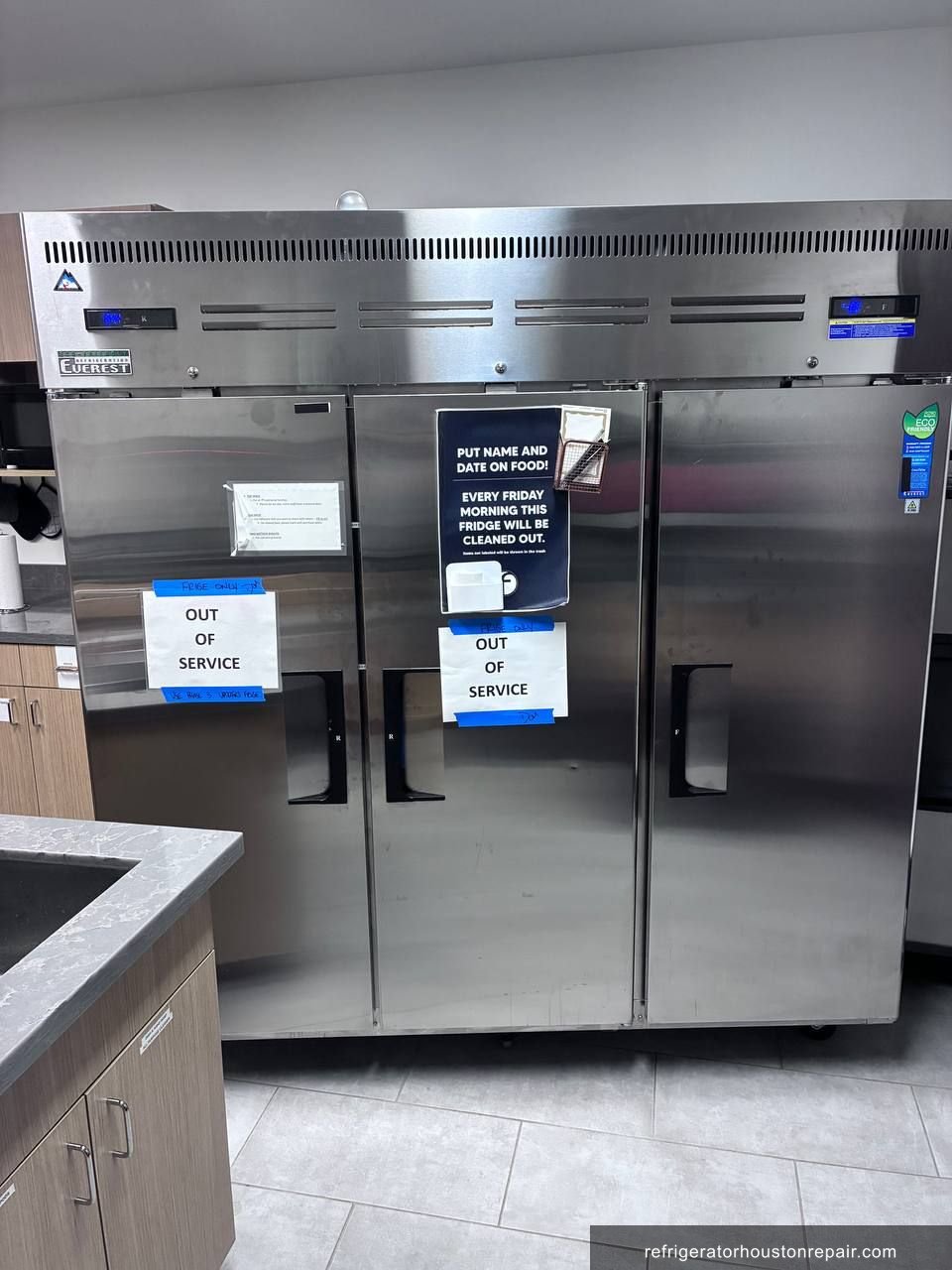
Everest ESRF3 Commercial Refrigerator Not Cooling — Compressor Replacement
📞 Call (346) 512-3688🔧 Performed by Alex Z.
The Problem
- •Refrigerator not cooling at all — interior temperature rising to ambient
- •Compressor running continuously or clicking off on thermal overload without cooling
- •No cold air circulating inside the commercial refrigerator cabinet
- •Product inside spoiling or reaching unsafe temperatures
- •Condenser fan operating normally but no refrigeration effect detected
🔍 Diagnosis
Upon arrival at the commercial establishment in The Woodlands, TX 77381, the technician performed a full diagnostic on the Everest ESRF3 commercial reach-in refrigerator (Serial: BSRF322050008, 115V×1Ph×60Hz, rated at 9A). The unit was confirmed to be operating on R-290 (hydrocarbon) refrigerant with a factory charge of 3.88 oz in recovery mode and 5.29 oz for full charge, as specified on the appliance label manufactured in Korea. The technician began by measuring supply voltage at the unit's power connection — confirmed at 115V, within tolerance. Amperage draw was tested using a clamp meter: the compressor was drawing significantly below the rated 9A, indicating an internal electrical failure rather than a mechanical overload condition. Manifold gauges were connected to the service ports; both high-side and low-side pressures were equalized and near ambient, confirming the compressor had completely lost pumping capacity and was not building differential pressure. A digital multimeter was used to test the compressor start relay, PTC starter, and run capacitor — the starting components showed resistance values outside acceptable range, indicating they had also failed, likely contributing to or resulting from the compressor failure. A halogen-safe leak detector rated for hydrocarbon refrigerants was used to verify there were no R-290 leaks at line sets, evaporator coils, or condenser connections. The sealed system was otherwise intact. Root cause confirmed: compressor mechanical failure with associated starting system degradation.
🔧 The Repair
- ✓Disconnected unit from power supply and allowed system pressures to stabilize; confirmed equalized pressure on R-290 manifold gauge set before beginning work.
- ✓Connected EPA-compliant R-290 hydrocarbon recovery machine to the service valve; performed full freon evacuation and captured existing refrigerant charge per EPA Section 608 regulations.
- ✓Removed refrigeration compartment panels and accessed the compressor bay; disconnected all electrical connections, start relay, PTC starter, and wiring harness from the failed compressor.
- ✓Unbraised the suction and discharge lines from the original Everest ESRF3 compressor using nitrogen purge technique to prevent oxidation scale inside the copper lines during the brazing process.
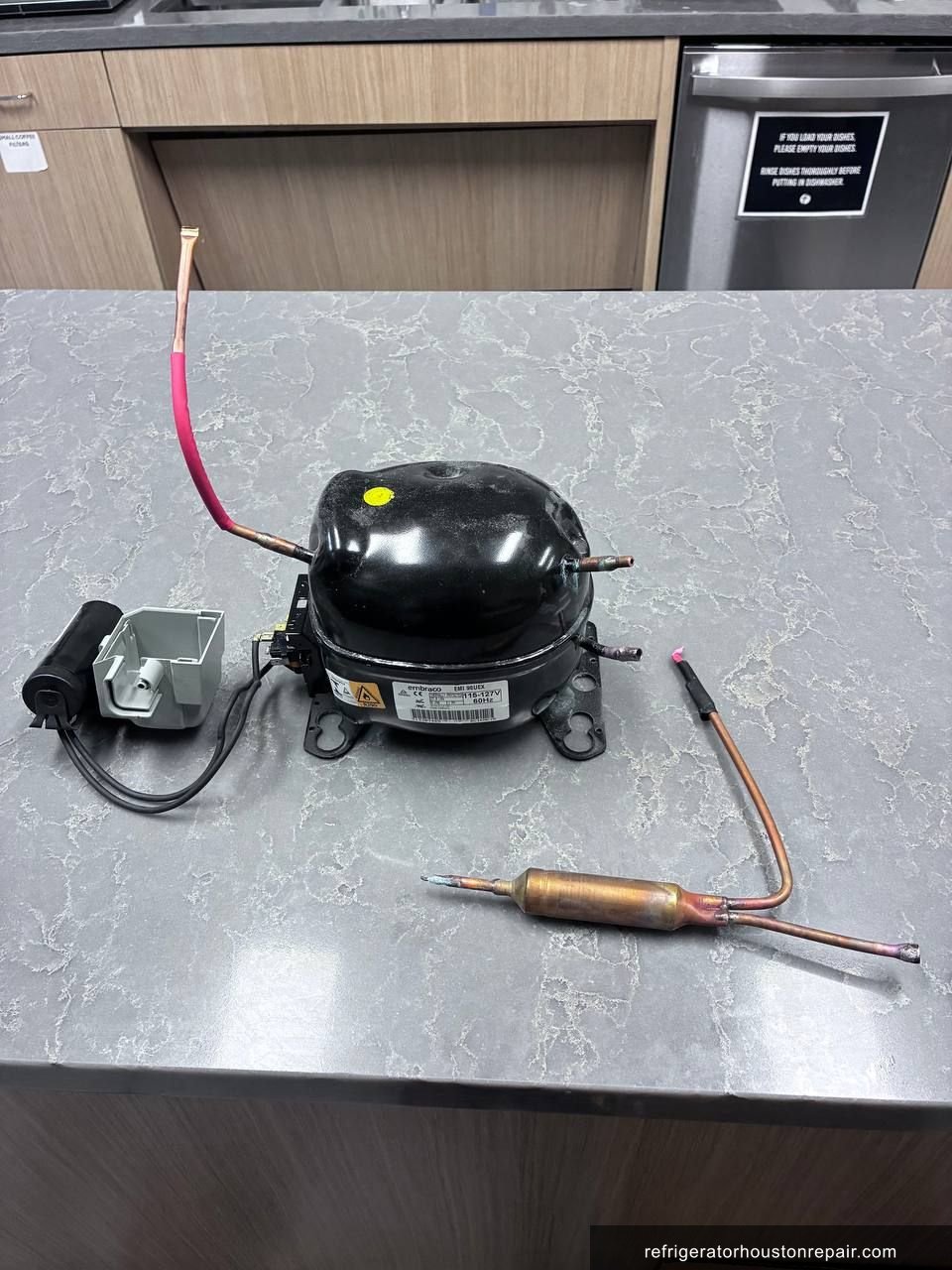
- ✓Removed the defective compressor from the mounting base; inspected compressor oil for contamination — oil appeared darkened, indicating internal motor winding breakdown consistent with electrical failure.
- ✓Installed the replacement compressor of matching specifications (compatible with R-290 refrigerant, rated voltage 115V×1Ph×60Hz, 9A), securing to mounting base with vibration-isolation grommets and hardware.
- ✓Replaced the compressor starting system including the PTC start relay and overload protector with new OEM-equivalent components rated for R-290 hydrocarbon refrigerant operation.
- ✓Installed a new bi-flow filter drier rated for R-290 hydrocarbon refrigerant service, replacing the existing drier to ensure all moisture and contaminants introduced during the repair were captured.
- ✓Installed a Schrader-type service valve on the process tube to facilitate future refrigerant service access without requiring line cutting.
- ✓Performed sealed system cleaning with dry nitrogen: pressurized system to 150 PSI with OFN (oxygen-free nitrogen), held pressure for 30 minutes to verify joint integrity, then released and repeated flush cycle to remove any residual debris and oxidation.
- ✓Connected vacuum pump rated for hydrocarbon systems; pulled deep vacuum on the sealed system, achieving a vacuum below 500 microns as verified by digital micron gauge — held vacuum for 30 minutes to confirm no leaks or moisture presence.
- ✓Charged the system with R-290 refrigerant by weight to the label specification of 5.29 oz (full factory charge); monitored manifold pressures and amperage draw during startup — compressor drew 8.8A, within the rated 9A spec, and suction/discharge pressures normalized confirming correct charge; verified cabinet temperature drop to 35°F within 90 minutes of operation.
✓ Result
Following the compressor replacement and full sealed system service, the Everest ESRF3 commercial refrigerator in The Woodlands, TX 77381 reached its target operating temperature of 35°F within 90 minutes of startup. The entire repair was completed within 3 days from the initial diagnostic visit, including parts procurement with expedited delivery. The business owner was relieved to have the unit back in service quickly with minimal product loss. A 90-day labor warranty and 1-year parts warranty were provided on the compressor and all replaced sealed system components.
💡 Technician Notes
Everest commercial refrigerators like the ESRF3 use R-290 (propane-based) hydrocarbon refrigerant, which requires technicians certified for flammable refrigerant handling — never attempt DIY sealed system work on these units. Compressor failures on Everest reach-ins often present gradually: watch for the unit running longer cycles before temperatures start rising. Keep condenser coils cleaned every 90 days in commercial kitchen environments — dirty condensers force the compressor to work harder and dramatically shorten its lifespan. Ensure adequate ventilation clearance around the unit (minimum 3 inches on all sides). Listen for unusual clicking sounds at startup, which indicate a failing start relay — catching this early can prevent full compressor failure. Schedule annual preventive maintenance checks including refrigerant pressure verification, electrical connection inspection, and door gasket integrity testing to maximize equipment longevity.
Frequently Asked Questions
Why did my Everest ESRF3 commercial refrigerator stop cooling completely?
The most common cause of an Everest ESRF3 losing all cooling is compressor failure. When the compressor fails internally, it can no longer pump refrigerant through the sealed system, causing temperatures to rise to ambient. This is confirmed by equalized high and low side pressures on manifold gauges and abnormal amperage readings at the compressor terminals.
How much does it cost to replace the compressor on an Everest ESRF3, and how long does the repair take?
A full compressor replacement on an Everest ESRF3, including sealed system service with R-290 recharge, filter drier, and starting components, typically ranges from $600 to $1,100 depending on parts availability. With expedited parts delivery, this repair can be completed in 2–4 days. Labor alone generally accounts for 3–5 hours of skilled technician time for a complete sealed system job.
What warning signs indicate the compressor is failing on an Everest commercial refrigerator before it stops cooling entirely?
Early warning signs on an Everest ESRF3 include longer-than-normal compressor run cycles, interior temperatures slightly warmer than set point, audible clicking sounds at startup (indicating a failing PTC relay), and the compressor feeling unusually hot to the touch. Addressing a failing start relay early can sometimes prevent full compressor failure and save significant repair cost.
Is it worth repairing an Everest ESRF3 commercial refrigerator with a failed compressor, or should I replace the unit?
For an Everest ESRF3 in otherwise good condition, compressor replacement is almost always cost-effective compared to purchasing a new commercial reach-in refrigerator, which can cost $2,000–$4,000+. If the unit is under 8 years old with no other major issues, a sealed system repair restores full function and typically includes a parts warranty, making repair the clear financial choice.
Is R-290 refrigerant in my Everest ESRF3 dangerous, and can any technician service it?
R-290 (propane) is a flammable hydrocarbon refrigerant used in many Everest commercial units for its excellent efficiency and low environmental impact. It requires technicians with specific EPA Section 608 certification and training for flammable refrigerant handling. The small charge quantity (5.29 oz in the ESRF3) minimizes risk when handled properly, but DIY service is strongly discouraged due to fire and explosion hazards.
Repair Summary
- Brand
- Everest
- Model
- ESRF3
- Repair Type
- Sealed System Repair / Compressor Replacement
- Refrigerant
- R-290
- Root Cause
- Failed compressor caused complete loss of cooling
- Parts Replaced
- ✓Compressor — R-290 compatible hermetic compressor, matched to Everest ESRF3 specifications (115V×1Ph×60Hz, 9A rating)
- ✓PTC Start Relay — OEM-equivalent solid-state PTC starter for R-290 compressor
- ✓Compressor Overload Protector — thermal overload compatible with replacement compressor
- ✓Bi-Flow Filter Drier — R-290 rated, installed inline on liquid line
- ✓Schrader Service Valve — process tube service valve for future refrigerant access
- ✓R-290 Refrigerant — 5.29 oz charged by weight per appliance label specification
- Location
- The Woodlands, TX 77381
- Status
- ✓ Completed
Service Area
We provide refrigerator repair service in The Woodlands and surrounding areas.
View The Woodlands Service Area →Need Everest Refrigerator Repair in The Woodlands?
We serve The Woodlands and all surrounding Houston areas. Same-day service available.